
You need a baler that works every day. A bad machine wastes time and money. I see this problem often. Here is how a hydraulic baler works.
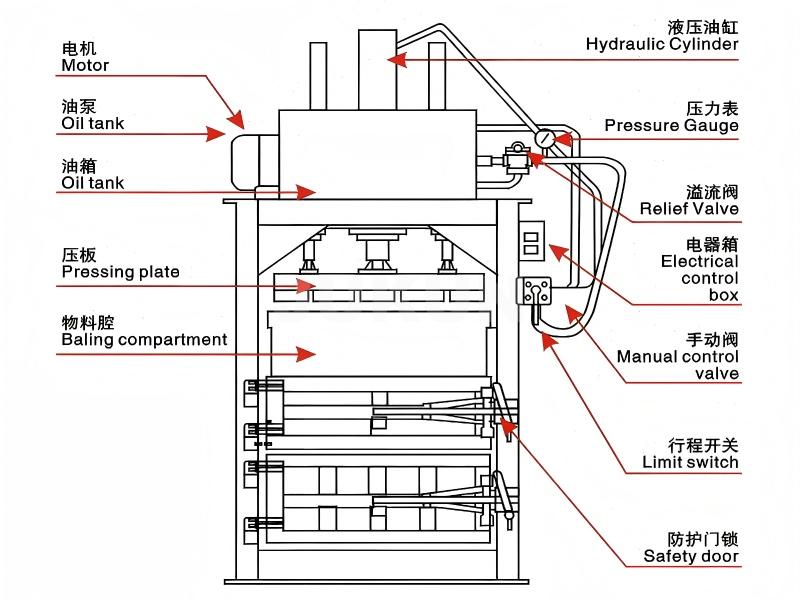
A hydraulic baler uses an electric motor to drive a pump. The pump supplies oil flow. System pressure builds against the load. Valves send oil to a cylinder, and the cylinder moves a ram that compresses material into a tied bale.
This process looks simple. But each part and each step affects bale quality. You need to understand the full system before you compare machines.
Get a hydraulic baler solution from our factory
What Is a Hydraulic Baler and How Does It Work?
Many buyers focus only on price. Then they get weak bales and slow cycles. I want you to avoid that mistake.
The hydraulic baler working principle converts hydraulic energy into mechanical force. The motor drives a pump that supplies oil flow. System pressure develops against load resistance. Control valves direct oil to the cylinder, which moves the ram to compress material.

A hydraulic baler is a complete system. Every part has a job. If you understand the system, you can judge machine quality. You can spot weak designs. You can avoid costly purchases.
These machines appear in many industries. Recycling centers use them. Paper mills use them. Warehouses use them. Packaging factories use them. Plastic recycling plants use them. Each setting has different requirements. Each setting needs a different machine setup.
What Is a Hydraulic Baling Machine?
You may hear two names. Some people say "hydraulic baler." Others say "hydraulic baling machine." Both names describe the same equipment. The machine uses oil pressure to compress waste material.
The goal is simple. Loose material goes in. A tight block comes out. That block is called a bale. A bale saves space. A bale is easy to move. A bale is easy to ship. This reduces storage costs and transport costs.
A correctly sized baler can reduce storage and transport costs. A poorly sized baler may slow your operation and raise labor costs. That is why you must understand the machine before you buy.
How Do Hydraulic Pressure, Cylinder Size, and Pump Flow Affect Baler Performance?
You must understand one basic rule. Force comes from pressure and area. Speed comes from flow and area. These two rules control the whole machine.
Compression force depends on hydraulic pressure and effective piston area. The formula is F = P × A. F is force. P is pressure. A is piston area. Ram speed depends on pump flow and piston area. The formula is v ≈ Q ÷ A. Q is flow. More pressure or a larger piston gives more force. More flow gives faster movement.
 A hydraulic pump mainly supplies oil flow. System pressure develops when oil meets resistance from the load. Pressure-relief valves and other circuit parts limit that pressure. So pump flow mainly affects ram speed. Working pressure and effective cylinder area determine the theoretical pushing force.
Here is an illustrative example. This is not a real machine specification. It only shows how the formula works. Suppose a cylinder has an effective piston area of 0.05 m². It operates at a pressure of 20 MPa. The theoretical pushing force is:
F = 20,000,000 × 0.05 = 1,000,000 N
This equals about 102 metric tons-force under ideal conditions. Real output is lower. Pressure losses, friction, and system limits reduce the actual force. This is a theoretical example, not a rated machine specification.
Buyers should ask whether the stated compression force is the theoretical cylinder force or the rated working force. Request supporting technical specifications. This helps you compare machines fairly.
Ask about hydraulic baler components and specifications
What Are the Main Components of a Hydraulic Baler?
A hydraulic baler contains many parts packed together. Each part depends on the others. If one part fails, the machine stops. You need to know these parts before you buy.
The main parts of a hydraulic baler are the electric motor, hydraulic pump, oil reservoir, hydraulic cylinder, compression ram, baling chamber, machine frame, control valves, hydraulic filter, electrical system, and bale tying system. They form a chain. The motor drives the pump. The pump moves the oil. The oil moves the cylinder. The cylinder moves the ram.
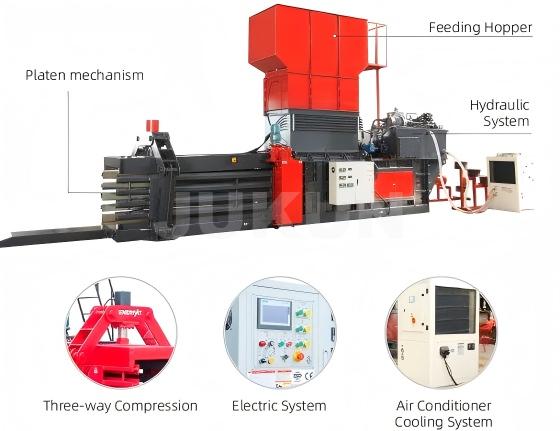 Here is a table that shows what each part does and how it affects performance.
| Component | Main Function | Performance Impact |
|---|---|---|
| Electric Motor | Drives the hydraulic pump | Motor power affects available system capacity |
| Hydraulic Pump | Supplies hydraulic oil flow | Pump flow affects cylinder movement speed |
| Oil Reservoir | Stores and helps cool hydraulic oil | Tank design supports oil supply and heat management |
| Hydraulic Cylinder | Converts hydraulic energy into linear force | Cylinder bore and pressure determine pushing force |
| Compression Ram | Pushes material inside the chamber | Ram design and guidance affect compression quality |
| Baling Chamber | Holds material and shapes the bale | Chamber strength affects bale dimensions and durability |
| Machine Frame | Supports the machine under load | Frame design affects structural stability |
| Control Valves | Regulate oil direction and pressure | Valve quality affects movement control and safety |
| Hydraulic Filter | Removes contaminants from the oil | Filtration protects pumps, valves, and cylinders |
| Electrical System | Controls the machine cycle | Wiring and controls affect safety and reliability |
| Tying System | Secures the finished bale | Tying method affects bale handling and transport |
Ask your supplier about each part. Ask for the brand. Ask for the size. Ask for the material grade. A good supplier will answer these questions. A poor supplier will change the subject.
How Does a Hydraulic Baler Work Step by Step?
The working cycle follows a clear sequence. It is not random. Each step must work well. If one step fails, the bale quality drops.
The hydraulic baler cycle has eight main steps. The steps are material feeding, motor and pump start, oil distribution, ram forward movement, material compression, ram retraction, bale formation and tying, and bale discharge. Some machines repeat the compression steps several times before tying.
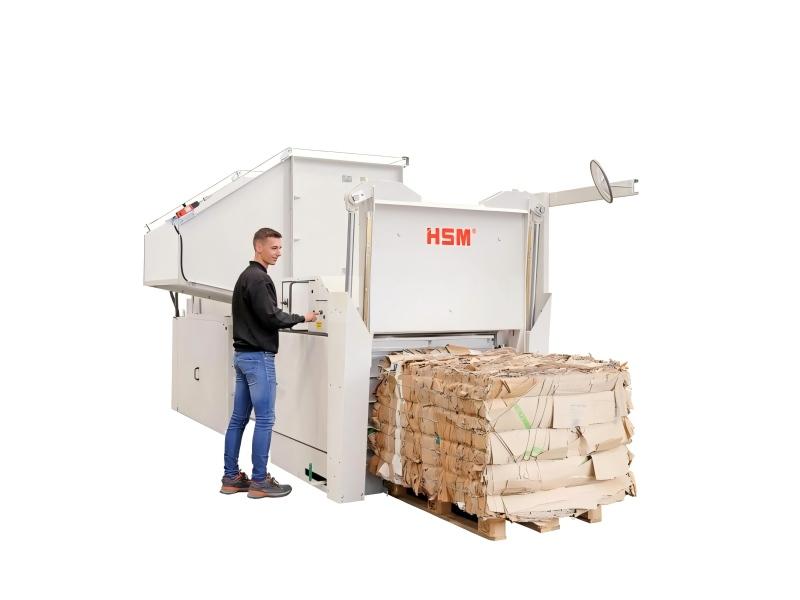 Not every machine works the same way. A vertical baler works differently from a horizontal baler. A semi-automatic baler works differently from a fully automatic baler. You must know these differences.
| Step | Working Process | Technical Explanation |
|---|---|---|
| 1 | Material Feeding | Material enters the baling chamber |
| 2 | Motor and Pump Start | The motor drives the hydraulic pump |
| 3 | Hydraulic Oil Distribution | Valves direct oil to the cylinder |
| 4 | Ram Forward Movement | The cylinder pushes the ram forward |
| 5 | Material Compression | Loose material is pressed into smaller volume |
| 6 | Ram Retraction and Reloading | The ram returns for another cycle when required |
| 7 | Bale Formation and Tying | The target bale is formed and secured |
| 8 | Bale Discharge | The finished bale is removed from the machine |
The exact operating sequence depends on the baler design. In a vertical baler, operators usually feed the material in batches and tie the bale manually. In a semi-automatic horizontal baler, material is compressed into a bale before the operator completes the tying process. A fully automatic horizontal baler may use an automatic tying system and integrated material feeding. Therefore, the cycle sequence and operator involvement vary by machine configuration.
Step six is very important. Many horizontal balers need several compression strokes. The ram moves forward. It compresses the material. It moves back. More material enters. The ram moves forward again. This repeats until the bale reaches the set length. Then the bale is tied.
You must also watch the hold time. Some materials spring back after compression. Plastic bottles spring back. Plastic film springs back. These materials need a longer hold time. If the hold time is too short, the bale looks fine at first. It opens up later during transport.
Request a working video of our hydraulic baler
What Materials Can a Hydraulic Baler Compress?
Not every machine works for every material. This is a common mistake. Many buyers think one machine can do everything. It cannot. You must tell the supplier exactly what you will bale.
A hydraulic baler can compress cardboard, waste paper, PET plastic bottles, plastic film, textile waste, and other suitable recyclable materials. But each material needs the right machine setup. You must check the feeding opening, chamber size, ram force, and tying system before you buy.
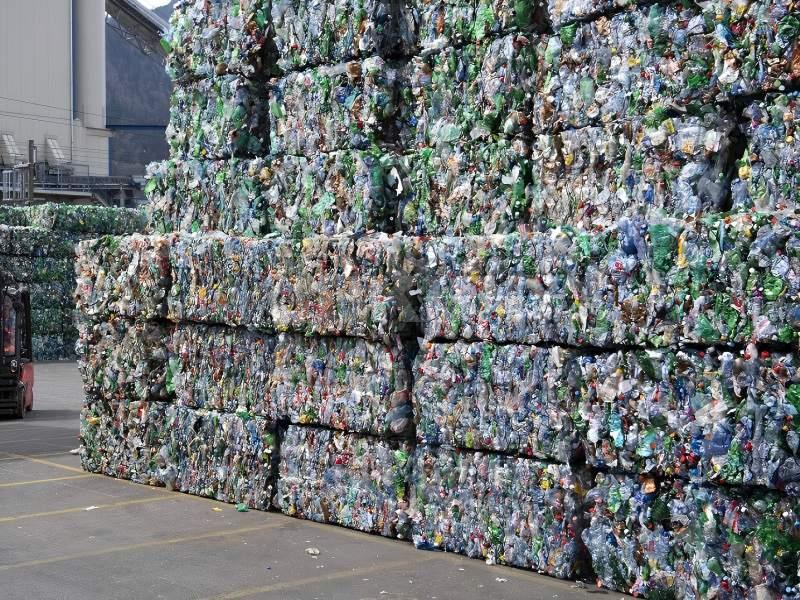 A machine built for paper is not built for metal. A machine built for light film is not built for dense cardboard. You must be honest with the supplier about your material. You must also test the material before you buy.
Cardboard and Waste Paper
Cardboard is the most common material. Warehouses have it. Supermarkets have it. Factories have it. A vertical baler works well for small shops. A horizontal baler works well for large plants.
Waste paper is also common. Printing shops have it. Offices have it. Paper mills have it. Waste paper compresses well. It is easy to bale. But the chamber must stay clean. Dust and dirt can enter the hydraulic system. Good filtration is important.
Why Should You Test PET Bottles Before Choosing a Hydraulic Baler?
PET bottles need special attention. Whole bottles trap air inside. That air affects compression. It affects bale stability. It affects the final bale weight.
You should test PET bottles before choosing a baler because bottle size, wall thickness, cap status, and air content change compression results. Test the actual bottles, record bale weight, dimensions, cycle time, and stability, and compare results with and without perforation.
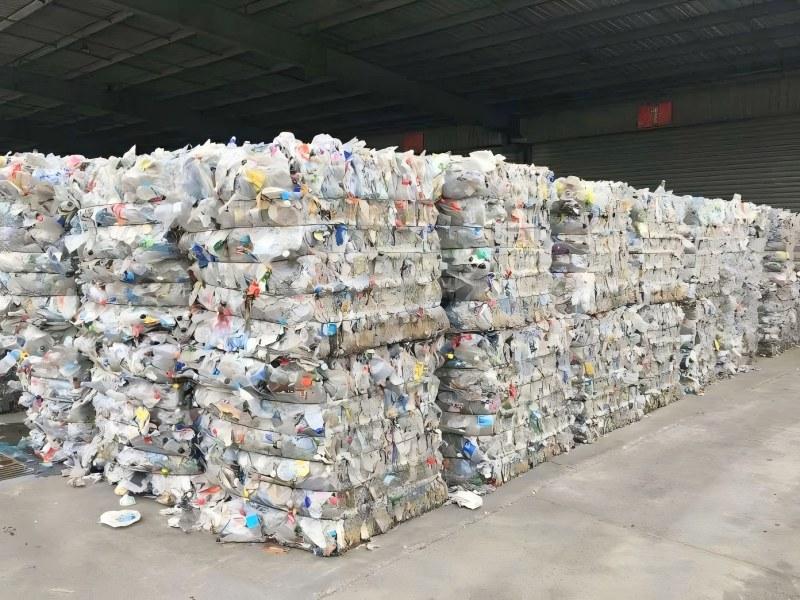 I recommend testing the actual bottles you plan to process. Record the bale weight. Record the bale dimensions. Record the compression cycle. Record the bale stability after discharge. If bottles retain too much air, compare the results with and without perforation. A material test helps determine whether your operation needs a bottle perforator, a different compression configuration, or a longer holding cycle.
Use a simple record table. Do not invent numbers. Fill it with real test data.
| Test Item | What to Record | Why It Matters |
|---|---|---|
| Bottle Condition | Whole, crushed, or perforated | Shows how air release affects compression |
| Bale Weight | Actual weight in kg | Verifies bale density and target weight |
| Bale Stability | Shape after discharge | Shows if the bale will survive transport |
| Cycle Time | Time per bale | Helps compare real throughput |
Plastic Film and Other Recyclable Materials
Plastic film is light and flexible. It wraps around things. It needs a special chamber design. The feeding opening must be right. The hold time must be long enough. If not, the bale falls apart.
Other materials need other machines. Textile waste needs a strong ram. Aluminum cans need a different setup. Metal scrap requires a dedicated heavy-duty metal baler with a suitable chamber, frame, hydraulic system, and compression configuration. A standard cardboard or PET bottle baler should not be used for metal scrap unless the manufacturer has specifically designed and approved it for that material.
| Material | Possible Configuration | Key Consideration |
|---|---|---|
| Cardboard | Vertical or horizontal | Daily volume and bale size |
| Waste Paper | Vertical or horizontal | Feeding method and bale density |
| PET Bottles | Suitable vertical or horizontal models | Bottle condition and air release |
| Plastic Film | Specialized vertical or horizontal models | Feeding and spring-back control |
| Textile Waste | Suitable textile baler | Material characteristics and bale stability |
Can one hydraulic baler handle different materials? The answer is maybe. It depends on the chamber size. It depends on the ram force. It depends on the feeding system. You must ask the supplier. You must test the material. Do not assume. Assumption costs money.
Find the right baler for your material
What Is the Difference Between Vertical and Horizontal Hydraulic Balers?
Vertical and horizontal balers share the same hydraulic principle. But they look different. They work differently. They serve different businesses. You must pick the right one for your volume.
A vertical hydraulic baler compresses material downward. It saves floor space. It often suits lower-volume operations. A horizontal hydraulic baler compresses material sideways. It often handles higher volumes. It suits recycling plants. The main differences are compression direction, footprint, feeding method, and automation level.
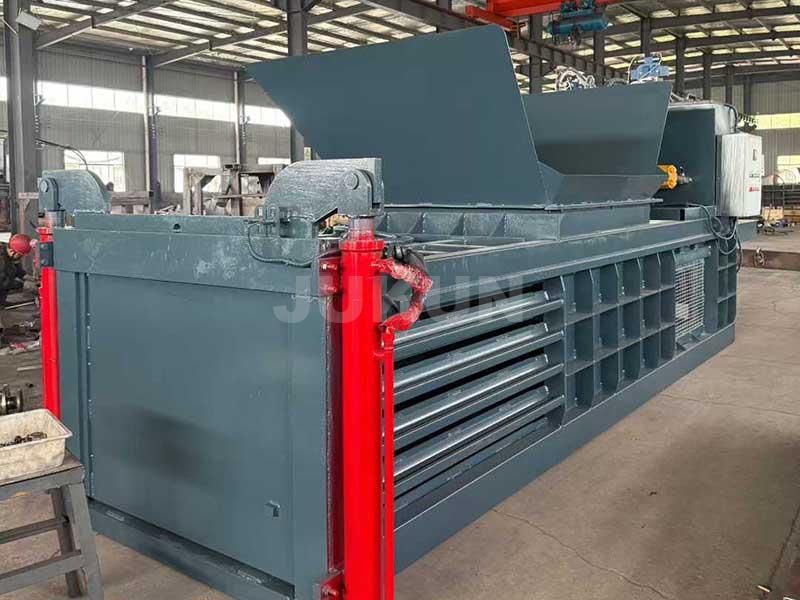 Many buyers pick the wrong type. They buy a vertical baler for a busy warehouse. Then they cannot keep up. Or they buy a large horizontal baler for a small shop. Then they waste money. You must match the machine to your daily volume.
A horizontal baler is not automatically the best choice for every large business. Buyers should compare actual throughput, bale weight, labor requirements, and total operating cost for each model.
How Does a Vertical Hydraulic Baler Work?
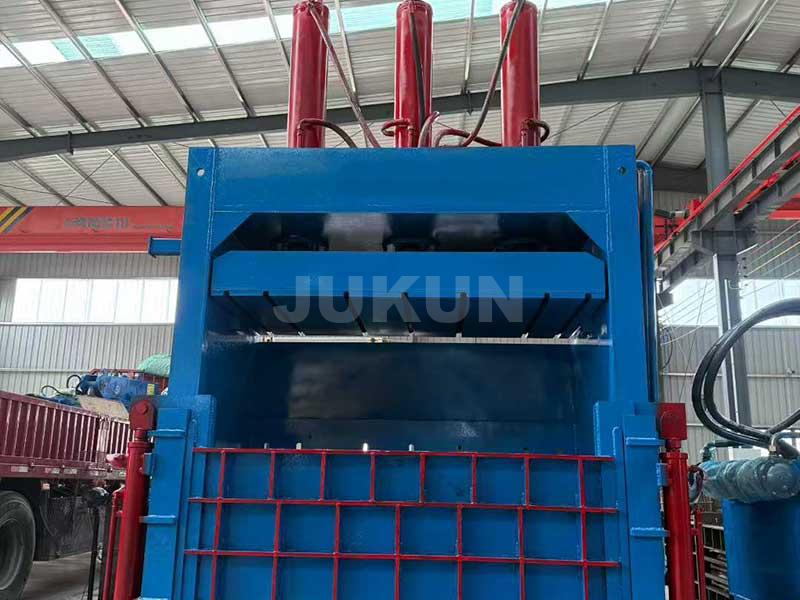
A vertical baler has a tall chamber. The cylinder sits on top. The ram moves down. It presses material against the floor. The operator loads material by hand. The operator ties the bale by hand. Then the bale is removed.
Vertical balers generally have a smaller footprint. They may have a lower initial purchase cost for smaller operations. Actual cost depends on the model and configuration. They are simple to run. They work well for small and medium volumes. Supermarkets use them. Small warehouses use them. Printing shops use them.
But a vertical baler has limits. It needs more operator time. It produces smaller bales. It may not keep up with high volume. If your business grows, you may need a horizontal machine.
How Does a Horizontal Hydraulic Baler Work?
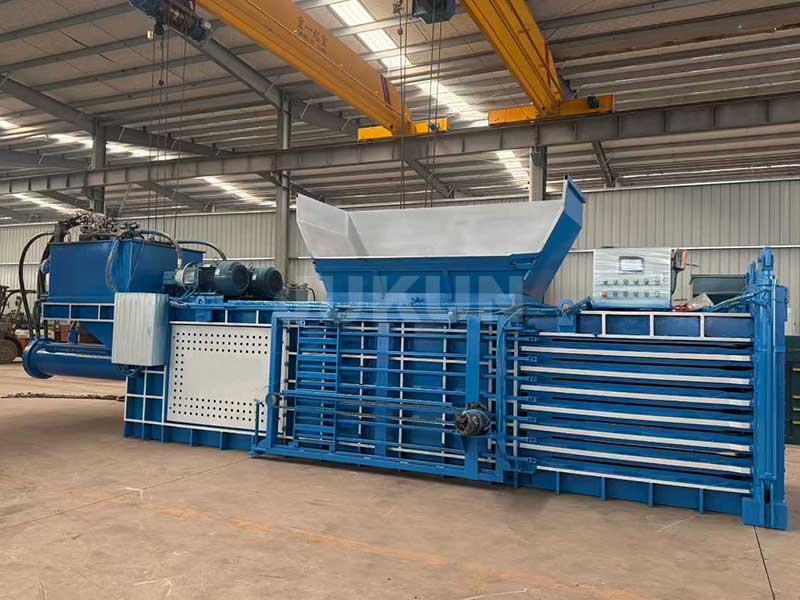
A horizontal baler has a long chamber. The cylinder sits on one side. The ram moves sideways. It pushes material along the chamber. The machine can be loaded by hand. It can be loaded by conveyor. It can run fully automatic.
Horizontal balers are often selected for higher-throughput applications. They can make large, heavy bales. They can run with less labor. They can connect to a full recycling line. Actual performance depends on the model and configuration. Recycling centers use them. Paper mills use them. Large warehouses use them.
But a horizontal baler has limits. It needs more floor space. It costs more to buy in many configurations. It needs more setup. If your volume is small, it may be too much machine.
| Comparison | Vertical Hydraulic Baler | Horizontal Hydraulic Baler |
|---|---|---|
| Compression Direction | Downward | Horizontal |
| Floor Space | Generally compact | Generally requires more space |
| Daily Volume | Often lower-volume operations | Often continuous or higher-volume operations |
| Feeding Method | Usually manual | Manual, conveyor, or automatic |
| Automation Level | Manual or semi-automatic | Semi-automatic or fully automatic |
| Labor Needs | Depends on feeding and tying method | Depends on automation configuration |
| Bale Size | Depends on chamber dimensions | Depends on chamber dimensions |
| Initial Cost | Compare actual quotations | Compare actual quotations |
Which type is better for your business? Ask yourself three questions. How much material do you process each day? How much floor space do you have? How much labor do you want to use? Your answers will point to the right machine.
Production capacity is not decided by vertical or horizontal design alone. It also depends on the specific model and configuration. You must compare actual rated capacity. Do not compare only the machine type.
Compare vertical and horizontal balers
How to Maintain a Hydraulic Baler for Reliable Operation?
Most machine failures are not sudden. They build up over time. Dirty oil. Worn seals. Loose hoses. These small problems become big problems. You must check your machine regularly.
You maintain a hydraulic baler by checking the oil level and oil condition, inspecting hoses and connections, cleaning or replacing filters, checking cylinder seals for leaks, inspecting the ram and chamber for wear, and testing all safety systems. The maintenance schedule must follow the machine manual and your working conditions.
 Always isolate electrical and hydraulic power before maintenance. Release stored hydraulic energy according to the manufacturer's safety procedures. Only qualified personnel should perform hydraulic and electrical maintenance. Safety comes first. It protects your workers. It protects your business.
Why Is Hydraulic Oil Cleanliness Important?
Hydraulic oil contamination can accelerate wear in pumps, valves, and other hydraulic components. Dust, metal particles, and water can affect system reliability. Use the oil grade and filtration requirements specified by the machine manufacturer. Follow the recommended inspection and replacement intervals.
You must check the oil level. The frequency depends on your machine manual. The manual also states the oil change interval. Follow it. Do not guess.
You must check the oil condition. Good oil is clear. Dark oil may indicate contamination or overheating. Milky oil may indicate water entry. But color alone is not proof. Oil condition needs proper testing. Check contamination, viscosity, and smell. Use an oil test when in doubt.
You must change the filter on schedule. The schedule depends on your machine manual. It also depends on your working environment. A dusty plant needs more frequent changes. A clean plant needs fewer changes.
Cylinder, Hose, and Valve Inspection
You must look for leaks. Check the cylinder seals. Check the hoses. Check the connections. A small leak becomes a big leak. A big leak means lost pressure. Lost pressure means weak bales.
You must listen to the machine. Strange noises are warning signs. But do not diagnose by sound alone. Knocking, whining, or hissing sounds need proper inspection. Check the oil level. Check the filter. Check the hoses. Call a technician if the problem continues.
Electrical and Safety System Checks
You must test the emergency stop. You must test the safety interlocks. You must check the wiring. Frayed wires are dangerous. Wet wires are dangerous. Loose connections are dangerous. Safety is not optional.
| Inspection Item | What to Check | Recommended Action |
|---|---|---|
| Hydraulic Oil | Level and visible condition | Follow the machine manual |
| Hydraulic Filter | Indicator and contamination | Clean or replace as specified |
| Hydraulic Hoses | Leakage, cracks, and damage | Repair or replace when necessary |
| Cylinder Seals | Oil leakage and wear | Inspect and replace when required |
| Electrical System | Wiring and connections | Inspect regularly |
| Safety Devices | Emergency stops and interlocks | Test according to safety procedures |
You must keep a maintenance log. Write down every check. Write down every repair. This log helps you spot patterns. It helps you plan for parts. A machine with a clean log is worth more.
What Should You Check Before Buying a Hydraulic Baler?
Price is important. But price is not everything. A cheap machine can cost you more. It breaks down. It makes bad bales. It has no spare parts. You lose money every day. A good machine costs more at first. But it works for years. It pays you back.
You should check the rated compression force, working pressure, motor power, pump flow, bale dimensions, target bale weight, tested throughput, feeding system, tying system, safety features, warranty, and after-sales support before buying a hydraulic baler. Ask for real test data. Do not rely on the price alone.
 Here are the key specifications you should confirm with any supplier.
| Specification | What Buyers Should Confirm | Why It Matters |
|---|---|---|
| Compression Force | Rated force and working pressure | Shows real pushing capacity |
| Motor Power | Motor rating in kW | Affects available system capacity |
| Hydraulic Pump | Pump type and rated flow | Affects ram speed and cycle time |
| Bale Size | Length × Width × Height | Must match storage and shipping needs |
| Bale Weight | Actual weight for the target material | Verifies density and transport cost |
| Throughput | Tested tons per hour for your material | Shows real production capacity |
| Feeding System | Manual, conveyor, or automatic | Affects labor needs and speed |
| Tying System | Manual, semi-automatic, or automatic | Affects bale security and labor |
Throughput is very important. Do not mix up material capacities. A machine that processes cardboard at a certain rate may not process PET bottles at the same rate. Always ask for a test result with your actual material.
What Test Results Should You Request from a Baler Manufacturer?
Before placing an order, ask the manufacturer to test your actual material or a representative sample. Request a video showing the complete feeding, compression, tying, and discharge process.
The test report should include the material type, bale dimensions, actual bale weight, cycle time, compression configuration, and any special equipment used. For PET bottles, also record whether perforation is required and how stable the bale remains after discharge.
These details help you compare machines based on real operating performance rather than marketing specifications alone.
Compression Force and Bale Dimensions
You must know your target bale. What size do you need? What weight do you need? The machine must match these numbers. Do not guess. Measure your material. Measure your shipping needs. Then pick the machine.
Compression force is important. But force alone does not make a good bale. Chamber design matters. Ram alignment matters. Hold time matters. A machine with high force but poor design makes bad bales.
Processing Capacity and Automation
You must know your daily volume. How many tons per day? How many hours per shift? The machine must handle this volume. Do not buy a machine that is too small. You will work overtime. You will miss deadlines.
Here is a simple example. These numbers are assumptions, not machine data. Suppose your facility processes 12 tons of cardboard per day. You run 8 hours per day. Your average required throughput is 1.5 tons per hour. But you must also account for loading interruptions, operator breaks, material fluctuations, and machine downtime. Request a practical throughput test. Do not select a model based only on the average calculation.
Automation is a choice. Manual machines cost less. They need more labor. Automatic machines cost more. They need less labor. You must do the math. Labor costs are high in many markets. Automation may pay off fast.
Manufacturer Experience and After-Sales Support
You must check the factory. How long have they built machines? Do they have a real factory? Can they show you a video call? Do they have spare parts? Do they answer your questions fast?
Ask the supplier to arrange a live factory video call. Ask them to show the production workshop. Ask them to explain how key components are inspected before shipment.
| Check Point | What to Ask | Warning Sign |
|---|---|---|
| Factory History | How many years in business? | Vague answers |
| Real Factory | Can we do a video call? | Excuses or delays |
| Spare Parts | Do you stock common parts? | No parts available |
| Certificates | Can you show CE or ISO? | Fake or unclear papers |
| Support | Who helps after the sale? | No clear contact |
You must also check the warranty. A good factory stands behind its machine. Ask for the warranty terms in writing. Ask for the after-sales contact. Ask for a response time promise.
Frequently Asked Questions About Hydraulic Balers?
Buyers often ask the same questions. The answers depend on the machine and the material. You should always check the manufacturer's rated data. Do not rely on general numbers alone.
Hydraulic balers vary by pressure, cycle time, and service life. The right answer depends on machine design, material, and maintenance. Always check the manufacturer's rated specifications and request a test with your material.
What Is the Working Principle of a Hydraulic Baler?
A hydraulic baler works by converting hydraulic energy into mechanical force. An electric motor drives a hydraulic pump. The pump supplies pressurized oil to a cylinder. The cylinder moves the compression ram to press recyclable materials into a compact bale. The finished bale is then tied and discharged.
What Factors Affect Hydraulic Baler Capacity?
Hydraulic baler capacity depends on material type, bulk density, feeding speed, cylinder configuration, pump flow, compression cycle, bale size, and automation level. Buyers should request throughput test results using the material they plan to process.
What Hydraulic Pressure Does a Baler Use?
The required hydraulic pressure depends on the machine design. It depends on the cylinder dimensions. It depends on the rated compression force. It also depends on the material being processed. Buyers should check the manufacturer's rated working pressure and technical specifications. Do not rely on a general pressure range.
How Long Does It Take to Produce One Bale?
Bale production time depends on the machine type. It depends on the material. It depends on the feeding method. It depends on the number of compression cycles. It depends on the target bale weight. It also depends on the tying system. The best way to evaluate cycle time is to request a demonstration using your actual material.
Can a Hydraulic Baler Compress Plastic Bottles?
Yes. A hydraulic baler can compress plastic bottles. But you must pick the right machine. Bottles trap air. Some machines need a perforator. Some machines need a longer hold time. You must test your bottles before you buy. Send a sample to the factory. Ask for a test video.
What Is the Difference Between a Baler and a Compactor?
A baler compresses recyclable materials into compact bales. These bales are secured with wire or straps. They are used for storage, handling, or recycling. A waste compactor reduces the volume of waste. It often works inside a container. It does not necessarily produce tied bales. The right choice depends on your goal. Choose a baler for recycling and bale handling. Choose a compactor for general waste volume reduction.
How Long Can a Hydraulic Baler Last?
The service life of a hydraulic baler depends on several factors. It depends on structural quality. It depends on hydraulic component quality. It depends on operating conditions. It depends on maintenance. It also depends on replacement of worn parts. Regular inspection and proper maintenance help extend equipment life.
Conclusion
A hydraulic baler uses a pump, cylinder, and ram to compress waste into bales. Check the factory and test your material before buying. Contact Jukun for help.