
Are you losing money on paper waste because it takes up too much space and costs too much to transport?
A horizontal paper baler is the best solution for compressing paper waste efficiently because it continuously produces high-density bales, which reduce storage space, cut transport costs by up to 80%, and turn your waste paper into a sellable commodity.
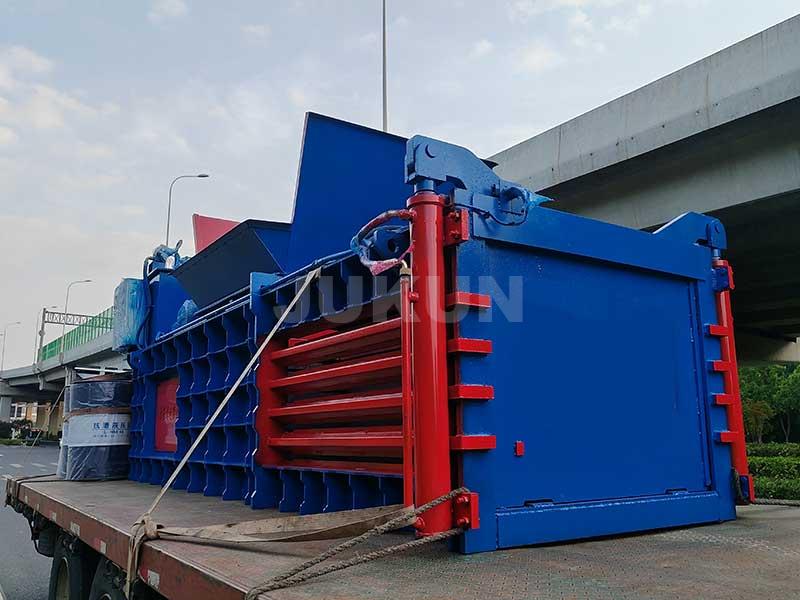
Paper waste is one of the biggest cost drivers in recycling operations. It is light, bulky, and expensive to move around. I have seen many business owners struggle with this exact problem. They fill up dumpsters quickly, pay high hauling fees, and miss out on the revenue their paper could generate. A horizontal paper baler fixes all of that. Let me show you how.
What Is a Horizontal Paper Baler and How Does It Work?
Have you ever watched a recycling facility turn a mountain of loose cardboard into neat, square bales and wondered what machine makes that possible?
A horizontal paper baler is a hydraulic machine that compresses paper waste into tight, rectangular bales using a horizontal ram that pushes material through a chamber until it reaches the preset size and density.
The operation is straightforward. You feed the paper into the machine. This can be done manually, with a forklift, or through a conveyor system for non-stop feeding. The hydraulic ram then pushes the material into the compression chamber. The ram moves back and forth, adding more material and compressing it with each stroke. Once the bale reaches the required length, the machine ties it automatically with wire or straps. The finished bale is then ejected onto a conveyor or pallet, ready for stacking and shipping.
The key difference between a horizontal baler and a vertical one is the continuous workflow. A vertical baler works in batches. You fill it, compress, tie manually, and empty it before you can start again. This stop-start cycle slows you down. A horizontal baler does not stop. It keeps running as long as material is fed into it. For a business that handles large volumes of paper every day, this continuous operation is a game changer.
Let me compare the two so you can see the contrast clearly.
| Feature | Horizontal Paper Baler | Vertical Paper Baler |
|---|---|---|
| Operation mode | Continuous | Batch (stop-start) |
| Bale density | Higher and consistent | Moderate |
| Labor needed | Low (automated tying) | Higher (manual tying) |
| Best for volume | High volume (5+ tons/day) | Low to medium volume |
| Bale weight | Up to 1,200 kg or more | Typically 200–600 kg |
| Conveyor compatibility | Yes | Limited |
If your business generates several tons of paper waste each day, the horizontal baler is the right choice. It keeps your operation moving, reduces the number of people you need on the floor, and produces bales that mills actually want to buy.
What Types of Paper Waste Can a Horizontal Paper Baler Compress?
Are you dealing with different kinds of paper waste and wondering if one machine can handle all of them?
A horizontal paper baler can compress almost all types of paper waste, including corrugated cardboard, office paper, newspaper, magazines, and mixed paper, as long as the material is dry and free from heavy contaminants.

This flexibility is one of the reasons I recommend horizontal balers to my clients. You do not need a separate machine for each type of paper. The same equipment handles cardboard from shipping, paper from office shredding, and old newspapers from collection drives.
Here is a breakdown of the common paper types and what to expect with each.
-
Corrugated cardboard (OCC): This is the most common material processed in horizontal balers. It compresses well and produces high-density bales that are in strong demand from paper mills. OCC bales typically weigh between 500 kg and 1,200 kg.
-
Office paper and mixed paper: These materials are lighter than cardboard but still compress effectively. A horizontal baler can handle them with no trouble. The bales may be slightly less dense than cardboard bales, but they are still valuable.
-
Newspaper and magazines: These materials are easy to bale. They do not require special adjustments to the machine. The bales hold their shape well and are easy to stack.
-
Shredded paper: This is the trickiest material because it is fluffy and full of air. A horizontal baler can handle it, but you may need a prep crusher to remove air before compression. The good news is that once baled, shredded paper takes up much less space than loose shreds.
-
Beverage cartons and similar packaging: Some facilities process these alongside paper waste. They compress well but may require a higher force setting.
The important thing to remember is that the paper must be dry. Wet paper does not bale well. It can also damage the machine over time and lower the quality of the bales.
Another factor to consider is contamination. Paper with heavy amounts of plastic, metal, or food waste will reduce the quality of your bales and may not be accepted by mills. Keep your paper stream as clean as possible to get the best price.
If you process a wide mix of paper types, look for a horizontal baler with adjustable pressure settings. This lets you dial in the right compression for each material.
Key Benefits of Using a Horizontal Baler for Paper Recycling
What advantages does a horizontal paper baler offer that make it worth the investment for your recycling business?
The key benefits include massive reductions in transport costs, significant labor savings, continuous high-volume processing, higher bale density that commands better market prices, and a cleaner, safer working environment.
I have worked with many business owners who were skeptical at first. They saw the upfront cost and hesitated. But once they saw the savings, they never looked back. Let me walk you through the numbers and the practical benefits.
Transport cost savings
This is the biggest win. Loose paper is mostly air. A truck full of loose cardboard carries very little weight. One client told me he was paying over $2,000 a month just to haul his paper waste to a recycling center. After installing a horizontal baler, he reduced his hauling trips from five per week to one. His monthly transport cost dropped to under $600. That is $1,400 in monthly savings. In a year, that is almost $17,000.
Labor savings
A horizontal baler runs with minimal supervision. Once it is set up, the automated tying system handles the baling process. Your staff do not have to stand there feeding material and tying bales by hand. One facility owner told me he moved two workers from the baler to other parts of the operation. They were able to process more material overall without hiring extra people.
Higher revenue from bales
Mills prefer dense, uniform bales. They pay more for them because they are easier to process and ship. A horizontal baler produces bales that meet mill specifications consistently. I have seen buyers get 10% to 20% higher prices for their bales just by switching from a vertical to a horizontal baler.
Continuous processing
A horizontal baler does not stop. You feed material, and bales come out the other end. This means you are not waiting for a cycle to finish. Your waste paper does not pile up. The operation flows smoothly from the receiving dock to the baler to the shipping area.
Cleaner and safer workspace
Paper waste takes up floor space and creates a mess. Loose paper is also a fire hazard. A horizontal baler keeps your facility organized. The paper goes straight into the machine. The bales stack neatly. Your floor stays clear. Your workers have a safer environment with fewer tripping hazards.
Environmental impact
When you bale paper efficiently, more of it gets recycled. Less paper ends up in landfills. This is good for your community and good for your reputation. Many customers today prefer to work with businesses that prioritize sustainability.
How to Choose the Right Horizontal Paper Baler for Your Business
With so many options on the market, how do you pick the right horizontal paper baler that fits your operation and budget?
To choose the right horizontal paper baler, you need to evaluate your daily paper volume, the types of paper you process, your available floor space, and your power supply, while also checking the supplier's quality control and after-sales support.

I have helped dozens of buyers make this decision. There is no one-size-fits-all answer. But there is a process that will lead you to the right machine. Here is what I recommend.
Step 1: Calculate your daily volume
This is the most important factor. A horizontal baler comes in different sizes. Some process 2 to 5 tons per day. Others process 10 to 20 tons or more. You need to match the machine to your throughput. Undersized machines cause bottlenecks. Oversized machines waste money.
Step 2: Identify your material mix
Are you processing only cardboard? Or do you have a mix of cardboard, office paper, and newspaper? Different materials compress differently. If you process multiple types, look for a two-ram baler. It handles mixed materials more effectively.
Step 3: Check your floor space and layout
Horizontal balers take up more floor space than vertical ones. Measure your space carefully. Also consider the layout. Do you have room for a conveyor? Where will the finished bales go? Plan the whole workflow before you buy.
Step 4: Verify supplier quality
This is where many buyers make mistakes. I have seen suppliers cut corners on steel thickness, use cheap hydraulic components, and ship machines that fail within months. Here is what I check:
- Welding quality: Ask about weld joint analysis. Good manufacturers test this.
- Hydraulic components: Look for names like Bosch, Rexroth, or Yuken. Avoid no-name parts.
- Certifications: ISO 9001 and CE certification are good signs.
- Warranty: A three-year parts warranty shows the supplier stands behind their product.
- Material certificates: Demand certificates with batch tracking. This ensures the steel meets quality standards.
Step 5: Request a test run
This is the best way to know if a machine works with your material. Ask the supplier to run your paper through the machine. If you are buying from overseas, ask for a video of the test. A reputable supplier will do this without hesitation.
Step 6: Consider logistics and payment
Shipping a heavy machine from China to Canada requires careful planning. Check the shipping terms. Are they CIF or FOB? What is the lead time? Delayed shipments can cost you business. Also discuss payment terms. A 30% deposit and 70% before shipment is common. But some suppliers offer more flexible terms for long-term relationships.
Step 7: Look beyond the price
I know price matters. But the cheapest machine is rarely the best value. Consider the total cost of ownership. A slightly more expensive machine with better components, stronger steel, and reliable support will save you money in repairs and downtime.
Conclusion
A horizontal paper baler cuts transport costs, reduces labor, processes high volumes continuously, and turns paper waste into revenue, making it the best choice for efficient paper waste compression.