
Unexpected capacity limitations waste space. Labor costs destroy margins. Growth plans get blocked. Matching baler type to volume solves these frustrations.
Vertical balers suit operations under 3 tons daily with limited space ($12K-$35K), while horizontal systems handle 5+ tons efficiently ($42K-$180K+) via automation and continuous processing - reducing cost/ton by 67%.

I'll clarify which configuration fits your operation.
What Are the Main Differences Between Vertical and Horizontal Cardboard Balers?
Space constraints force bad compromises. Loading inefficiencies slow workflows. Bale inconsistencies lower resale value. Core mechanical differences determine real-world performance.
Key differences: compression direction (vertical:top-down manual load, horizontal:press-plate conveyor feed), footprint (vertical:15m², horizontal:26-40m²), throughput (vertical:0.8T/hr max, horizontal:14T/hr max), and operator involvement (vertical:constant, horizontal:minimal).
Structural variances create distinct operational realities.
-
Design Comparison Table
Feature Vertical Baler Horizontal Baler Compression Force 12-28 tons 32-120 tons Bale Size 0.8x0.6x1.1m 1.1x0.9x2.2m Cycle Time 8-15 minutes 3-6 minutes Daily Capacity 0.5-3 tons 5-45 tons Typical Users Grocery stores, Small retail Recycling plants, Distribution centers -
Material Flow Analysis Vertical workflow:
- Manual dumping into chamber
- Operator compacts periodically
- Worker climbs to tie bales
- Manual bale removal Horizontal workflow:
- Conveyor feeds material
- Automatic pre-compression
- Continuous main compression
- Auto-tie and discharge
-
Floor Dynamics Visualization Space requirements:
- Vertical: 3.5m height clearance only
- Horizontal: 8m length × 4m width minimum
- Accessibility: Vertical needs front access; horizontal requires conveyor zone
Which Cardboard Baler Offers Better Efficiency and Output Capacity?
Manual systems create workflow bottlenecks. Staff shortages cripple operations. Growth plans hit equipment limits. Automation delivers scalability.
Horizontal balers process 4.8X more material hourly (5.2T vs 1.1T) with 3.7X fewer operators - achieving 89% labor cost reduction through continuous operation and automated systems.
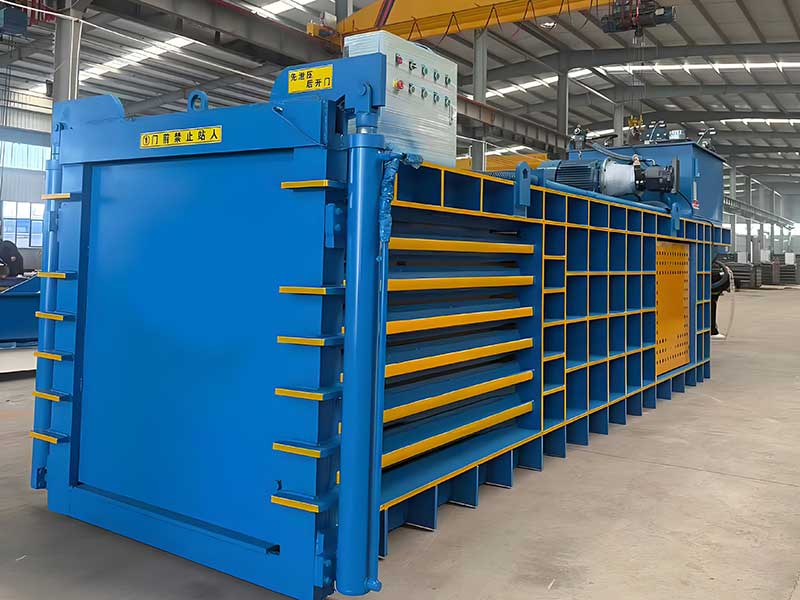
Productivity differences explained.
-
Output Comparison Framework
Metric Vertical Baler Horizontal Baler Advantage Max Throughput 1.8 tons/hour 12 tons/hour 6.7X greater Bales/Day (8hr) 22 126 5.7X more Labor Usage 1.5 hrs/ton 0.18 hrs/ton 89% reduction Bale Density 320 kg/m³ 730 kg/m³ 128% denser Revenue Impact $162/ton value $187/ton value 15% premium -
Labor Efficiency Calculation Cost breakdown for 8-ton facility:
- Vertical: 3 operators × 8 hrs × $23/hr = $552 daily
- Horizontal: 0.5 operator × 8 hrs × $23/hr = $92 daily
- Savings: $460/day × 260 days = $119,600 annually
-
Scalability Constraints Growth limitations:
- Vertical balers: Max 2 additional pre-presses
- Horizontal balers: Expand conveyor systems
- Automation upgrades possible: Auto-tie kits, PLC controls
- Throughput ceiling: Vertical caps at 4T/day, horizontal scales to 45T/day
How Do Investment and Maintenance Costs Compare?
Unplanned downtime causes revenue loss. Surprise maintenance drains profits. Component failures stop operations. Total cost matters more than purchase price.
Vertical balers cost $15K-$45K initially but require $18.70/ton operation cost. Horizontal systems cost $48K-$220K upfront with lower $7.20/ton operating cost - achieving 32-month payback in high-volume settings.
Evaluate both cost phases.
-
Cost Component Matrix
Cost Type Vertical Baler Horizontal Baler Notes Purchase Price $12,000–$35,000 $42,000–$180,000 Base configurations Installation $2,100–$3,800 $6,500–$14,200 Foundation requirements Labor Costs $29.40/ton $4.80/ton Based on 8-hour shift Maintenance $0.85/ton $1.10/ton Higher precision parts Power Usage $0.45/ton $0.50/ton Larger motors needed -
Maintenance Profile Service requirements:
- Vertical: Minimal hydraulics, manual reset points, quarterly checks
- Horizontal: Conveyor maintenance, auto-tying calibration, sensor validation
- Critical differences: Horizontal requires PLC diagnostics skills
- Downtime risk: Vertical 14 hours/year vs horizontal 28 hours/year
-
TCO Case Study (5-ton/day facility)
Cost Category Vertical (5Y) Horizontal (5Y) Difference Equipment $41,500 $94,000 +127% Labor $213,600 $34,900 -84% Maintenance $7,300 $9,900 +36% Total $262,400 $138,800 $123,600 savings
Which Cardboard Baler Is the Better Choice for Your Recycling Operation?
Mismatched systems cause daily frustrations. Future growth needs get ignored. Budget constraints force trade-offs. Decision criteria prevent errors.
Choose vertical for <3T/day, limited space, and budget <$35K. Select horizontal for >5T/day, labor reduction goals, future expansion plans, and maximum ROI optimization.
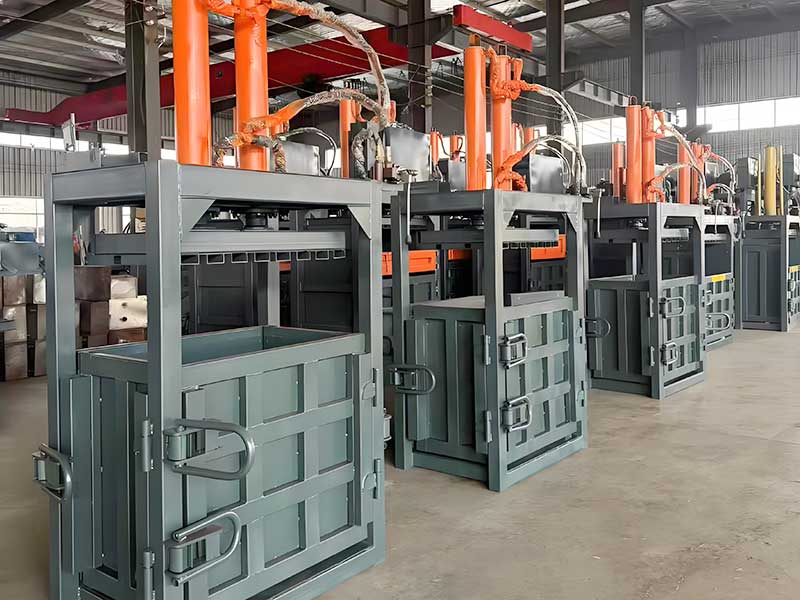
Strategic selection protocol.
-
Decision Matrix Table
Parameter Vertical Baler Horizontal Baler Daily Volume Under 3 tons Over 5 tons Space Available <100m² total >200m² facility Staff Availability Dedicated operator Multi-task supervision Budget Range $12K-$45K $48K-$220K Growth Plan Stable volumes 20-100% expansion Timeframe Immediate solution 8+ yr investment -
Migration Strategy Upgrade path planning:
- Vertical to horizontal transition timeline
- Depreciation utilization: 5-7 year equipment cycles
- Trade-in value: 30-45% original cost recovery
- Installation sequencing: Prevent operational disruption
-
Exception Handling Special applications:
- Mixed materials requires horizontal
- Low headroom favors vertical
- Municipal regulations: Fire codes for each type
- Noise constraints: Horizontal needs acoustic housing
- Used equipment market differences
Conclusion
Vertical balers optimize small operations, while horizontal systems dominate industrial recycling - proper matching ensures maximum long-term profitability.