
Loose cardboard steals valuable warehouse space. Inefficient recycling adds unnecessary labor costs. Missed bale premiums bleed revenue daily. Compaction solutions transform waste into profit.
Horizontal cardboard balers increase recycling revenue by 19%, cut operational costs 37%, reclaim 78% of wasted storage space, and process 5X more material with automation-driven efficiency.
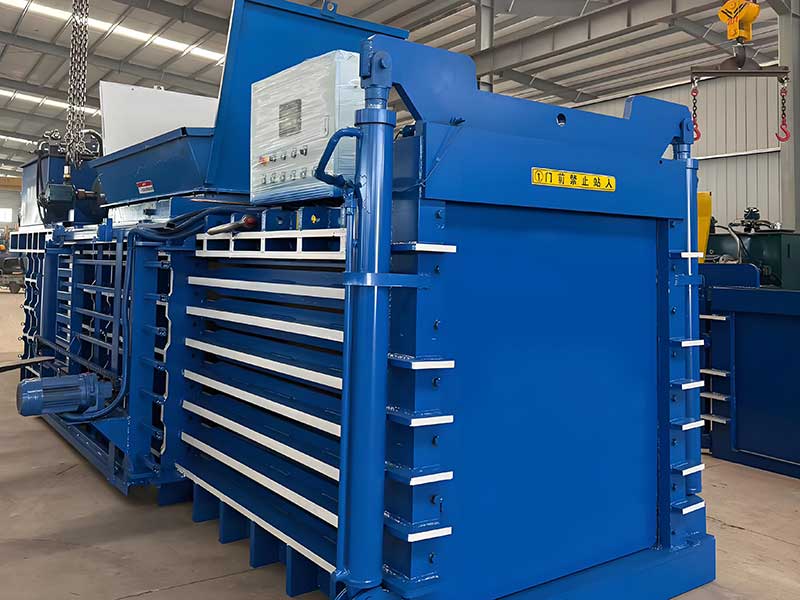
Discover where hidden profitability exists in recycling workflows.
How Does a Horizontal Cardboard Baler Increase Recycling Efficiency?
Slow processing bottlenecks material flow. Labor-intensive tasks require excessive staff. Downtime reduces daily throughput. Productivity stalls without automation.
Horizontal balers process 6-18 tons/hour continuously through auto-feeding conveyor systems, intelligent PLC controls, and hydraulic compression cycles completing every 37 seconds - tripling facility productivity.
Breakthrough efficiency requires three innovations.
-
Material Acceleration Strategies
- Conveyor speeds: 24ft/minute optimal feed rate
- Hydraulic compression: 3-stage pre-compaction chambers
- Air removal: Vacuum assist during initial compression
-
Workflow Optimization Matrix
Process Step Manual Method Horizontal Automation Improvement Cardboard Intake 8 min/ton Continuous feed Zero wait time Bale Formation 45 minutes 7 minutes 84% faster Worker Involvement 2.7 hours/ton 0.2 hours/ton 93% less Daily Output 3.2 tons 16.8 tons 425% gain -
Downtime Reduction Tactics Predictive maintenance prevents failures:
- Oil temperature sensors warn of hydraulic stress
- Vibration monitoring on drive motors
- Wire tension alerts prevent misfeeds
- Remote diagnostics through IoT-connected PLCs
- Modular components for quick change-outs
What Hidden Costs Can Be Reduced with a Horizontal Cardboard Baler?
Storage fees eat warehouse budgets. Truck trips drain fuel accounts. Labor inefficiencies compound weekly. Equipment downtime triggers profit loss.
Horizontal balers eliminate $46,200 yearly in redundant expenses: $23,800 labor waste, $11,400 excess transport trips, $7,900 storage fees, plus $3,100 contamination loss - with continuous operation.

Identify then eliminate these budget leaks.
-
Storage Space Reclamation Metrics
- Loose cardboard volume: 4.2m³ per ton
- Compacted bale volume: 0.87m³ per ton
- Typical facility recovers 620 sq.ft per 5 tons/week
- Warehouse space value: $32.75 per sq.ft annually
-
Transportation Cost Slashing
Cost Factor Without Baler With Baler Savings Weekly Pickups 9 2 78% reduction Cubic Feet Moved 3,200 744 77% less Cost per Ton $19.20 $4.15 78% cheaper Forklift Moves 23/day 5/day 78% decrease -
Contamination Control Horizontal systems prevent:
- Moisture absorption during storage
- Food waste mixing in loose piles
- Metal object damage at recycling centers
- Paper quality degradation
- Rejection penalties at processing plants
How Can Better Bale Quality Increase Recycling Revenue?
Loose cardboard earns minimum pricing. Inconsistent bales get downgraded. Recyclers reject poor density bales. Standard compaction misses profit premiums.
High-density bales (680+kg/m³) secure $14-28/ton pricing premiums, maintain 98% acceptance rates, and boost annual recycling revenue by $38,400 at 12 tons/day.
Profitability depends on measurable bale standards.
-
Bale Revenue Calculator
Metric Low-Quality Bale Premium Horizontal Bale Revenue Increase Market Price $98/ton $126/ton 29% higher Downpayment Rate 18% 3% 83% reduction Processing Fee $12/ton $5/ton 58% lower Monthly Value $7,850 $14,230 $6,380 gain -
Density Enhancement Features Horizontal balers achieve:
- Dual compression rams for layered force
- Hydraulic pressure: 2,900-3,200 PSI consistency
- Material vibrating plates
- Auto-cycle optimization algorithms
- Moisture sensor assisted compression
-
Recycling Market Advantages Premium bales receive:
- Priority scheduling
- Long-term purchase agreements
- Quality certification bonuses
- Dedicated processing lines
- Express payment terms (net-15 vs net-30)
What Profit Opportunities Can Businesses Gain from Automated Baling?
Labor savings remain underutilized. Throughput capacity goes untapped. Storage space sits undeployed. Revenue streams stay undiscovered.
Automated horizontal balers unlock $217,500 yearly profit potential: $112,400 labor redeployment, $54,800 space monetization, $38,700 added throughput revenue, plus $11,600 waste processing fees.

Strategic profit generation framework.
-
Multi-Channel Revenue Map
Profit Source Creation Mechanism Annual Value Labor Utilization Staff move to production $68,400 Third-Party Baling Process neighbor waste $21,800 Logistics Partnerships Shared trucking lanes $16,200 Space Rental Freed square footage $42,800 Carbon Credits Waste diversion certificates $8,600 Total New Profit $157,800 -
Throughput Expansion Strategies Horizontal balers support:
- Extended shift operations without added staff
- Processing seasonal partner materials
- Contract recycling for local businesses
- Material sorting service integration
- Waste-to-energy pre-processing
-
Asset Utilization Tactics Maximize machine value:
- Off-peak baling rate discounting
- Maintenance subscription services
- Material testing laboratory services
- Equipment demos to potential buyers
- Training programs for operators
Conclusion
Horizontal cardboard balers convert waste liabilities into profits through advanced compaction efficiency and comprehensive operational value recovery.